Jun 05, 2026
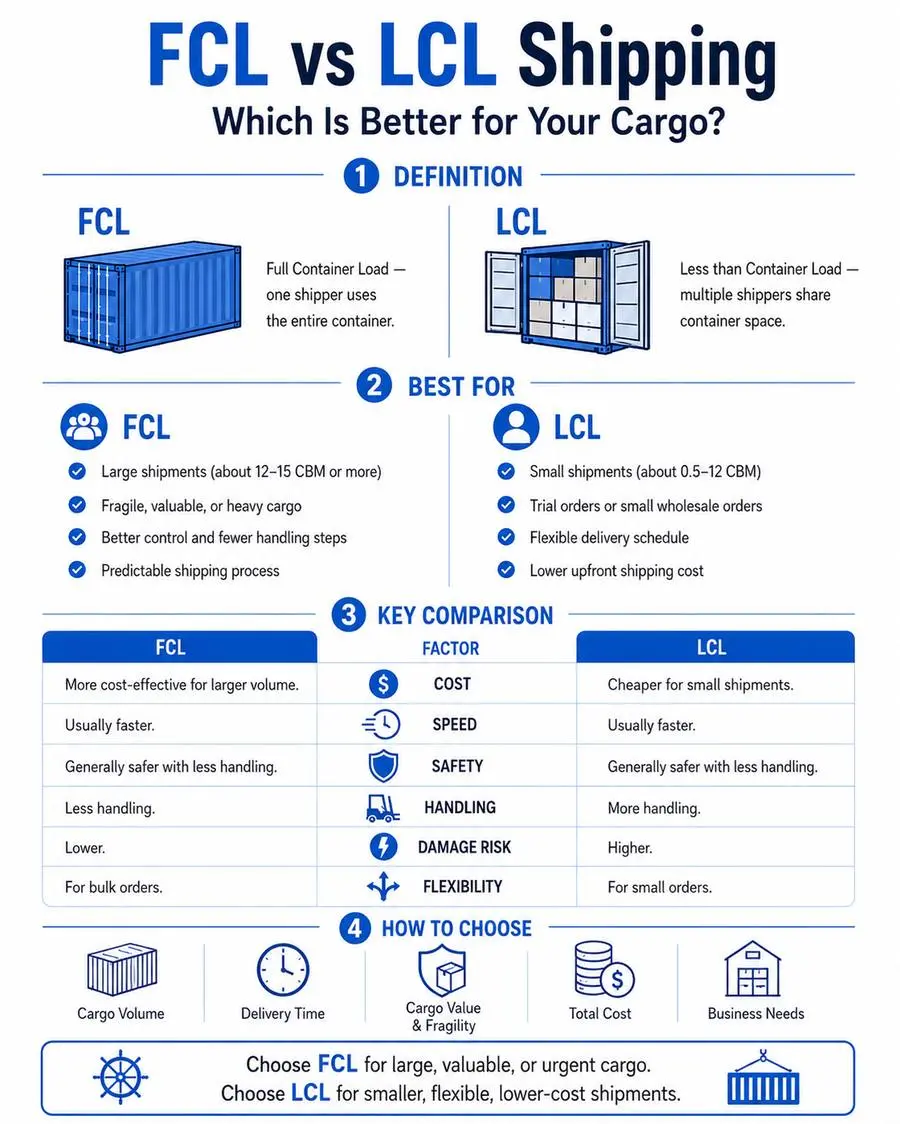
FCL vs LCL Shipping: Which Is Better for Your Cargo?
FCL surcharges are additional charges applied to a full container load shipment on top of the basic ocean freight rate. These fees may be charged by ocean carriers, terminals, ports, freight forwarders, customs-related service providers, or destination agents.
In simple terms, the base ocean freight pays for the container’s movement by sea. Surcharges cover extra cost factors that are not always included in that base rate, such as fuel fluctuations, currency changes, port handling, equipment imbalance, peak season demand, security compliance, and administrative processing.
For example, a quote from Shanghai to Los Angeles may include:
Ocean Freight
BAF
CAF
Origin THC
Destination THC
Documentation Fee
Seal Fee
AMS Filing Fee
Chassis Fee
Trucking or Drayage Fee
That is why two freight quotes with the same ocean freight rate can still produce very different total costs.
FCL surcharges exist because ocean shipping costs are affected by many variables beyond the vessel space itself. Fuel prices move. Exchange rates change. Ports increase handling tariffs. Some routes face congestion. Certain seasons create container shortages. Carriers and logistics providers use surcharges to separate these variable costs from the base freight rate.
From a carrier’s perspective, this structure makes pricing more flexible. From a shipper’s perspective, it can make quotations harder to compare. A low base rate may look attractive, but if the surcharge structure is incomplete or unclear, the final invoice may be much higher than expected.
The professional way to evaluate FCL pricing is not to ask, “What is the ocean freight?” but rather, “What is the all-in cost, and which charges are included or excluded?”
BAF stands for Bunker Adjustment Factor. It is a fuel-related surcharge used in ocean freight. “Bunker” refers to the fuel used by vessels. Since fuel is one of the largest operating costs for ocean carriers, BAF helps carriers adjust freight pricing when fuel prices rise or fluctuate.
For FCL shipments, BAF may be charged per container, usually based on container type such as 20GP, 40GP, or 40HQ. In some trade lanes, it may be included in the ocean freight. In others, it appears as a separate line item.
BAF is important because it can change regularly. Some carriers adjust it monthly or quarterly, depending on fuel cost formulas and market conditions. If your shipment moves during a period of fuel volatility, BAF may have a noticeable impact on total freight cost.
No. Ocean freight is the base transportation charge for moving the container by sea. BAF is an additional fuel adjustment charge. However, in some quotations, BAF may be bundled into the ocean freight rate, especially when the forwarder provides an “all-in ocean freight” quote.
This is why importers should ask whether the quoted freight is “all-in” or whether fuel surcharges are billed separately.
CAF stands for Currency Adjustment Factor. It is a surcharge used to offset exchange rate fluctuations. International shipping involves multiple currencies: freight may be quoted in USD, local charges may be paid in RMB, EUR, GBP, or other currencies, and carriers may have operating costs in different markets.
CAF helps carriers or logistics providers reduce the risk caused by currency movement. For example, if a carrier’s costs are partly in one currency but freight is collected in another, a sharp exchange rate change may affect revenue and operating margin.
In practice, CAF is less visible on some modern FCL quotes than BAF or THC. It may be listed separately, built into the ocean freight, or replaced by other pricing mechanisms depending on the carrier, route, and contract.
Shippers should pay attention to CAF when shipping on long-term contracts, volatile currency routes, or when comparing quotes from different forwarders. If one quote includes CAF and another excludes it, the cheaper quote may not actually be cheaper.
CAF matters most when you are managing repeat shipments and trying to control landed cost over several months. A small percentage difference can become significant across dozens of containers.
THC stands for Terminal Handling Charge. It is one of the most common FCL charges. THC covers the cost of handling a container at the port terminal. This may include container loading, unloading, movement within the terminal, stacking, and terminal-related operations.
There are usually two types of THC:
Origin THC is charged at the port of loading. It covers terminal handling before the container is loaded onto the vessel.
Destination THC is charged at the port of discharge. It covers terminal handling after the container is unloaded from the vessel.
For example, if you ship a 40HQ container from Ningbo to New York, there may be a China origin THC and a U.S. destination THC. Depending on your Incoterms, the seller, buyer, or another party may be responsible for paying these charges.
THC is related to terminal operations, but it may be collected through the carrier, freight forwarder, or local agent. This can confuse importers because the charge may appear on a carrier invoice, forwarder invoice, or destination agent invoice.
The key point is that THC is not the same as customs duty, trucking, or warehouse handling. It is specifically connected to terminal handling at the port.
Although BAF, CAF, and THC are all FCL surcharges, they are not the same type of cost. They come from different cost drivers.
| Surcharge | Full Name | Main Purpose | Cost Driver | Usually Charged By |
|---|---|---|---|---|
| BAF | Bunker Adjustment Factor | Covers fuel cost fluctuation | Vessel fuel price | Carrier or forwarder |
| CAF | Currency Adjustment Factor | Covers exchange rate fluctuation | Currency movement | Carrier or forwarder |
| THC | Terminal Handling Charge | Covers port terminal handling | Terminal operation cost | Carrier, terminal, or agent |
The easiest way to understand the difference is this:
BAF is about fuel.
CAF is about currency.
THC is about port handling.
A professional FCL quote should clearly show whether these charges are included, excluded, or subject to change.
BAF, CAF, and THC are important, but they are not the only fees in FCL shipping. Below are other common charges importers should understand.
PSS stands for Peak Season Surcharge. It is charged when demand is high and vessel space becomes tight. This commonly happens before major retail seasons, holidays, or during supply chain disruptions.
For example, exporters in Asia may face PSS before the back-to-school season, Black Friday, Christmas, or Chinese New Year shipping rush. PSS is usually temporary, but it can be expensive during strong market demand.
GRI stands for General Rate Increase. It is a planned increase in freight rates announced by ocean carriers. GRI is not exactly the same as a surcharge, but it affects the final cost of FCL shipping.
A GRI may be applied when carriers want to raise market rates on specific trade lanes. It may be introduced at the beginning or middle of a month, depending on carrier strategy and market conditions.
For shippers, the important point is timing. A quote valid today may not remain valid after a GRI takes effect. If your cargo is not ready before the cutoff date, the final freight may increase.
EBS stands for Emergency Bunker Surcharge. Like BAF, it is related to fuel cost. The difference is that EBS is usually introduced in response to sudden or exceptional fuel cost increases.
BAF is often more regular and formula-based. EBS is more reactive and temporary. If fuel prices rise sharply or vessels need to take longer routes because of geopolitical or operational disruptions, carriers may introduce EBS to recover extra fuel cost.
LSS stands for Low Sulfur Surcharge. It is connected to environmental fuel regulations. Ships may need to use lower-sulfur fuel or comply with emissions requirements, and LSS helps recover those additional fuel-related costs.
LSS may be included in BAF or shown separately, depending on the carrier and trade lane.
A documentation fee covers the administrative cost of preparing and processing shipping documents. In FCL shipping, this may include the bill of lading, booking confirmation, shipping instructions, manifest submission, and related document handling.
This fee is usually not very large compared with ocean freight, but it matters for companies shipping frequently. If you ship many containers each month, documentation fees can add up.
A seal fee is charged for the container seal used to secure the loaded container. For international FCL shipments, the seal number is recorded on shipping documents and may be checked by customs, terminals, and carriers.
Although the seal fee is usually small, it is still part of the origin cost structure. For higher-security shipments, the seal type may also matter.
These are advance cargo information filing fees required by different customs authorities.
AMS is commonly associated with shipments to the United States. ENS is used for the European Union. ACI is used for Canada. These filings provide shipment information to customs before the cargo arrives.
For FCL shipments, filing accuracy is important. Incorrect filing may lead to delays, amendments, penalties, or customs issues.
A chassis fee is common in the United States. A chassis is the trailer frame used to move a container by truck. In some markets, the chassis is not automatically included in the ocean freight or drayage cost.
For U.S. imports, chassis fees can become a meaningful part of destination cost, especially when port congestion, equipment shortage, or long waiting time is involved.
Demurrage is charged when a container stays at the port or terminal longer than the allowed free time. For example, if the consignee does not complete customs clearance or pick up the container within the free time period, demurrage may apply.
Demurrage is not a standard surcharge that applies to every shipment. It is an avoidable penalty-style cost caused by delay.
Detention is charged when a container is taken out of the terminal but not returned within the allowed free time. For example, if a trucker pulls the container from the port and the importer keeps it at the warehouse for too long before returning the empty container, detention may apply.
The simple difference is:
Demurrage happens when the container is still at the terminal.
Detention happens when the container is outside the terminal.
Both can become expensive if cargo clearance, delivery appointment, warehouse unloading, or empty return planning is not well managed.
No. FCL surcharges vary by country, port, carrier, trade lane, container type, season, and service scope. A charge that is common in the United States may not be charged the same way in Europe, Southeast Asia, or the Middle East.
For example, U.S. destination costs may include chassis fees, PierPass-related charges in some locations, pre-pull fees, yard storage, or special delivery appointment fees. European shipments may involve different customs and port charge structures. China origin charges may include booking, THC, documentation, seal, VGM, and customs-related local fees.
This is why importers should not use a single old shipment as the pricing benchmark for every route. FCL pricing must be checked by lane, port pair, Incoterm, and delivery model.
Incoterms determine which party is responsible for different parts of the shipment cost and risk. They do not erase surcharges, but they help define who should pay them.
The buyer usually pays almost all logistics costs, including pickup, export handling, origin charges, ocean freight, destination charges, customs clearance, and final delivery.
The seller usually pays the cost until the cargo is loaded on board at the origin port. The buyer usually pays ocean freight, freight-related surcharges, destination charges, customs clearance, and inland delivery.
The seller pays the ocean freight and insurance to the destination port, but the buyer often pays destination charges, import customs clearance, duties, taxes, and final delivery.
The seller is responsible for most or all costs up to final delivery, including freight, customs clearance, duties, taxes, and delivery, depending on the agreed DDP scope.
For buyers, this means a “cheap FOB price” does not always mean a cheap landed cost. You still need to calculate the freight and destination-side charges.
This is a common issue in FCL shipping. Some quotations show a low ocean freight rate to attract the customer, but the total cost becomes higher once local charges, destination fees, documentation charges, or delivery costs are added.
This does not always mean the forwarder is dishonest. Sometimes the quote scope is simply different. One forwarder may quote port-to-port. Another may quote door-to-door. One may include destination THC. Another may exclude it. One may include customs clearance. Another may list it separately.
However, from a shipper’s perspective, the risk is the same: comparing only the base ocean freight can lead to the wrong decision.
The best practice is to request a full charge breakdown with clear inclusion and exclusion terms.
To compare FCL quotes professionally, importers should not only look at the first number. They should compare the full cost structure.
Ask these questions:
A door-to-door quote includes more services than a port-to-port quote. Comparing them directly is misleading.
If not, the final invoice may be higher than the quoted freight.
THC can appear on both sides of the shipment. Make sure you know whether origin THC and destination THC are included.
Ocean freight can change quickly. A quote without a clear validity date is risky.
A 20GP, 40GP, and 40HQ do not always have proportional pricing. A 40HQ may be more cost-effective for bulky cargo, but only if the cargo volume justifies it.
These are often outside the ocean freight quote unless the service is DDP or door-to-door.
Some fees, such as customs exam, storage, demurrage, detention, waiting time, or port congestion fees, may not be predictable before shipment.
FCL charges can be divided into fixed, variable, and conditional charges.
Fixed charges are predictable and usually apply to most shipments. Examples include documentation fee, seal fee, booking fee, and standard THC.
Variable charges change based on market conditions. Examples include BAF, CAF, PSS, GRI, and EBS.
Conditional charges only apply when something specific happens. Examples include demurrage, detention, customs exam fee, storage, amendment fee, waiting time, and container cleaning fee.
This distinction is important because not all “extra charges” are the same. Some are normal parts of the freight structure. Others are avoidable costs caused by delay, incorrect documents, late pickup, or poor coordination.
Some FCL surcharges can be negotiated, but not all. Carrier-controlled surcharges such as BAF, THC, or PSS may be difficult to remove, especially during tight market conditions. However, freight forwarders may have better contract rates, bundled pricing, or more flexible service options.
Negotiation is usually more realistic when the shipper has:
Regular shipment volume
Predictable trade lanes
Flexible shipping dates
Accurate cargo forecasts
Good payment history
Long-term cooperation with the forwarder
Small importers may not be able to negotiate every surcharge, but they can still avoid unnecessary costs by requesting transparent quotes and planning shipments earlier.
Shippers cannot eliminate every surcharge, but they can reduce avoidable costs.
Booking late during peak season increases the risk of PSS, premium rates, rolled bookings, and limited vessel space.
If the cargo is not ready, you may miss the sailing and face revised rates or extra local charges.
Demurrage and detention often happen because importers do not know the free time limit. Always confirm free time at destination before the vessel arrives.
Incorrect consignee details, HS codes, cargo descriptions, or filing information can cause amendments, customs delays, and extra fees.
An all-in quote is not always cheaper, but it is usually easier to evaluate. It reduces the risk of hidden or unexpected line items.
Using a 40HQ instead of a 40GP may improve cost efficiency for lightweight and bulky cargo. But for heavy cargo, a 20GP may be more suitable due to weight limits.
A good freight forwarder should not only provide a number. They should explain which charges are fixed, which are variable, and which are avoidable.
A professional FCL quote should include:
Port of loading
Port of discharge
Place of delivery if door service is included
Container type
Commodity description
Gross weight and cargo volume
Ocean freight
BAF, CAF, THC, and other surcharges
Origin local charges
Destination local charges
Customs clearance scope
Trucking or drayage cost
Free time at destination
Quote validity
Exclusions
Payment terms
If a quotation only says “FCL shipping cost: USD X,” it is not detailed enough for serious cost control.
Many importers lose money not because the freight rate is high, but because the quote is misunderstood.
One common mistake is comparing only the ocean freight rate. Another is ignoring destination charges. Some buyers also assume that FOB means everything is handled once the cargo leaves the factory, when in reality the buyer still needs to manage ocean freight and destination costs.
Another mistake is failing to ask about free time. A shipment may look profitable until demurrage and detention appear after arrival. For time-sensitive shipments, free time can be as important as freight rate.
Some importers also overlook customs exam risks. Customs exams are not standard charges, but if they happen, they can create extra cost and delay. A professional quote should mention that customs exams, storage, duties, taxes, and penalties are excluded unless specifically included.
The best way to understand FCL surcharges is to separate them by cost driver. BAF is related to fuel. CAF is related to currency. THC is related to terminal handling. PSS and GRI are related to market conditions. Documentation, seal, and filing fees are administrative. Demurrage and detention are delay-related costs.
For importers, the goal is not to memorize every abbreviation. The real goal is to understand what is included, what is excluded, what can change, and what can be avoided.
A transparent FCL quote should help you answer three questions:
What am I paying for?
Who is charging it?
Can this cost change before or after shipment?
Once you can answer these questions, FCL pricing becomes much easier to manage. You can compare forwarders more accurately, avoid hidden costs, and build a more reliable landed cost calculation for your international supply chain.
Tell us your cargo details. We help U.S. importers, Amazon sellers, and e-commerce businesses arrange shipping from Chinese suppliers to U.S. warehouses, stores, or FBA centers.