May 25, 2026
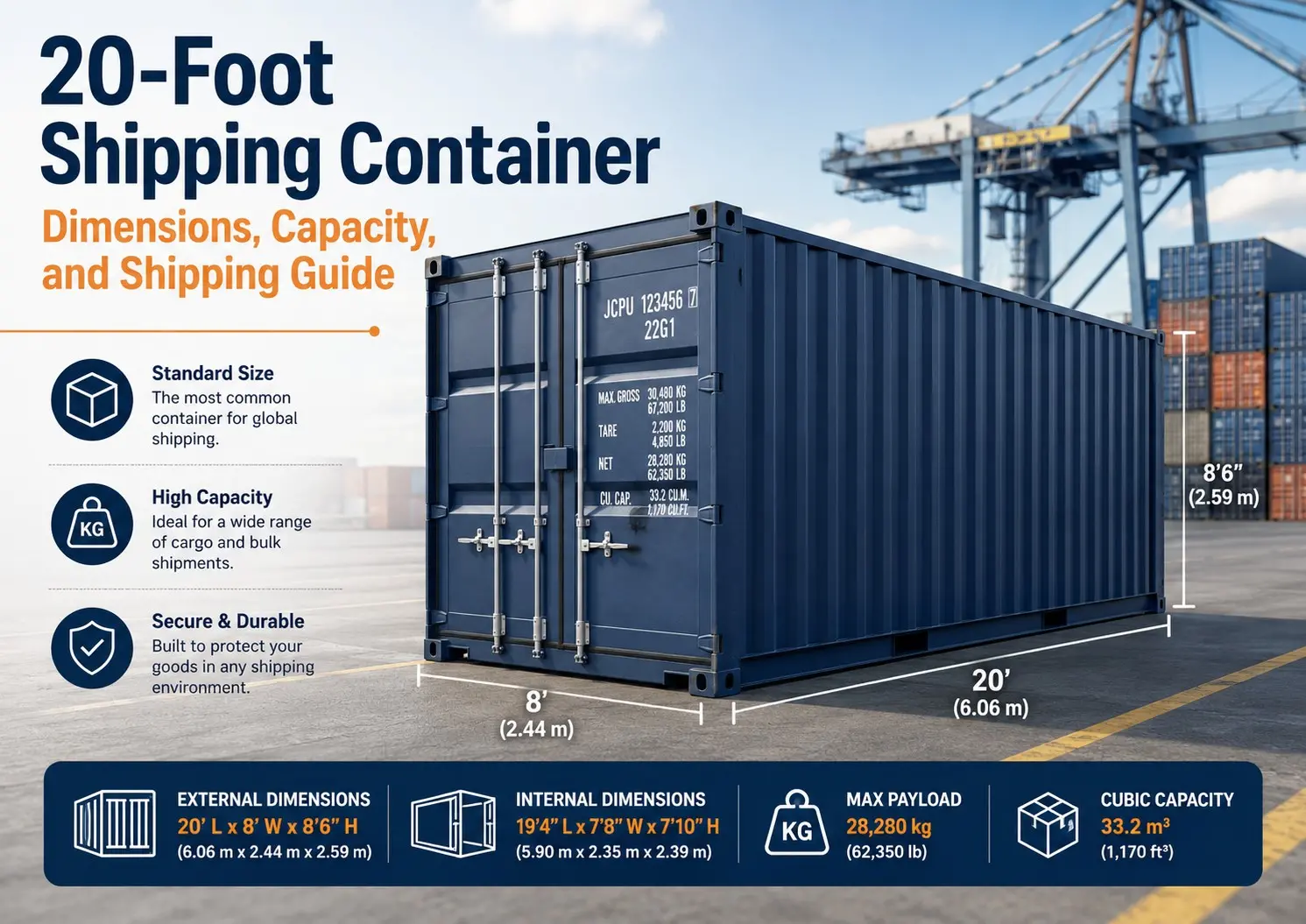
20-Foot Shipping Container Dimensions, Capacity, and Shipping Guide
You can calculate the CBM of a rectangular package by multiplying its length, width, and height in meters. This simple calculation helps you describe your shipment, plan cargo space, and request freight quotes. However, accurate results depend on the measurements you use. Your figures should describe the packed cargo that the carrier will handle.
CBM stands for cubic meter. It describes volume, or the amount of space something occupies. One CBM equals the volume of a cube that measures one meter along each edge.
The National Institute of Standards and Technology identifies the cubic meter, written as m³, as the SI unit of volume in its guide to volume measurements.
In shipping, CBM helps describe cartons, crates, and pallet loads. It does not tell you how heavy those packages are.
You should first check whether your dimensions use meters, centimeters, or millimeters. Each formula below gives the volume of one rectangular package in cubic meters.
| Measurement unit | Formula for CBM |
|---|---|
| Meters | Length × Width × Height |
| Centimeters | Length × Width × Height ÷ 1,000,000 |
| Millimeters | Length × Width × Height ÷ 1,000,000,000 |
You must use the same unit for all three dimensions. If every carton has identical dimensions, you can multiply one carton's CBM by the carton count. If carton sizes differ, you should calculate each size group separately and add the results.
The following examples use assumed measurements.
Example 1: Identical cartons
Your shipment contains 20 cartons. Each carton measures 60 cm long, 40 cm wide, and 50 cm high.
The volume of one carton is:
60 × 40 × 50 ÷ 1,000,000 = 0.12 CBM
The total carton volume is:
0.12 × 20 = 2.4 CBM
Example 2: Different carton sizes
Your shipment contains ten cartons measuring 60 × 40 × 50 cm. It also contains five cartons measuring 80 × 50 × 40 cm.
The first group occupies 0.12 × 10 = 1.2 CBM. The second group occupies 0.16 × 5 = 0.8 CBM. Your combined carton volume is therefore 2 CBM.
These totals describe the cartons before any additional pallet packing. A finished pallet load may occupy more space.
You should measure the outside of the finished packaging. Product dimensions alone can leave out cartons, padding, or wooden crates.
For palletized goods, you should measure the complete load, including the pallet base. You should also include any cargo that extends beyond its edges. For example, a finished load measuring 1.2 × 1.0 × 1.5 meters occupies 1.8 CBM.
You should calculate the CBM again after any change to the packaging. You should not add the carton total to the full pallet volume, because that would count the same cargo twice. Your packing list should show the final dimensions and quantities. You should also tell the forwarder whether your goods can be stacked.
For irregular goods, you should provide the maximum outer dimensions and photos. Your forwarder can confirm how the carrier will assess the occupied space.
If several suppliers prepare your order, EFAN's China warehousing and consolidation services can support packing and pallet preparation before shipment.
CBM measures volume. Gross weight includes the goods and their packaging. Two shipments can occupy the same volume but have very different weights.
Air freight also uses volumetric weight. The International Air Transport Association explains that carriers generally compare actual and volumetric weight. Its air cargo pricing guidance describes a common calculation that divides cubic centimeters by 6,000.
Under that rule, 1 CBM produces about 166.67 kg of volumetric weight. This figure represents a pricing measure. It does not mean the shipment actually weighs 166.67 kg. You should confirm the divisor and rounding rules for your service.
LCL shipping combines cargo from several shippers in one container. Its charges commonly depend on volume or weight. FCL gives one shipper dedicated container space, even when the container is not completely full. EFAN's FCL and LCL comparison explains these options.
Your CBM total alone cannot determine the final bill. Your quote should also identify applicable handling and delivery charges.
Before you request a shipping quote, you should provide package dimensions, quantities, gross weight, pickup location, and destination.
International Air Transport Association. “Air Cargo Tariffs and Rules: What You Need to Know.” IATA, 27 July 2021. Accessed 11 Sept. 2026.
National Institute of Standards and Technology. “SI Units - Volume.” NIST, 2 Mar. 2026. Accessed 11 Sept. 2026.
Tell us your cargo details. We help U.S. importers, Amazon sellers, and e-commerce businesses arrange shipping from Chinese suppliers to U.S. warehouses, stores, or FBA centers.