Oct 10, 2026
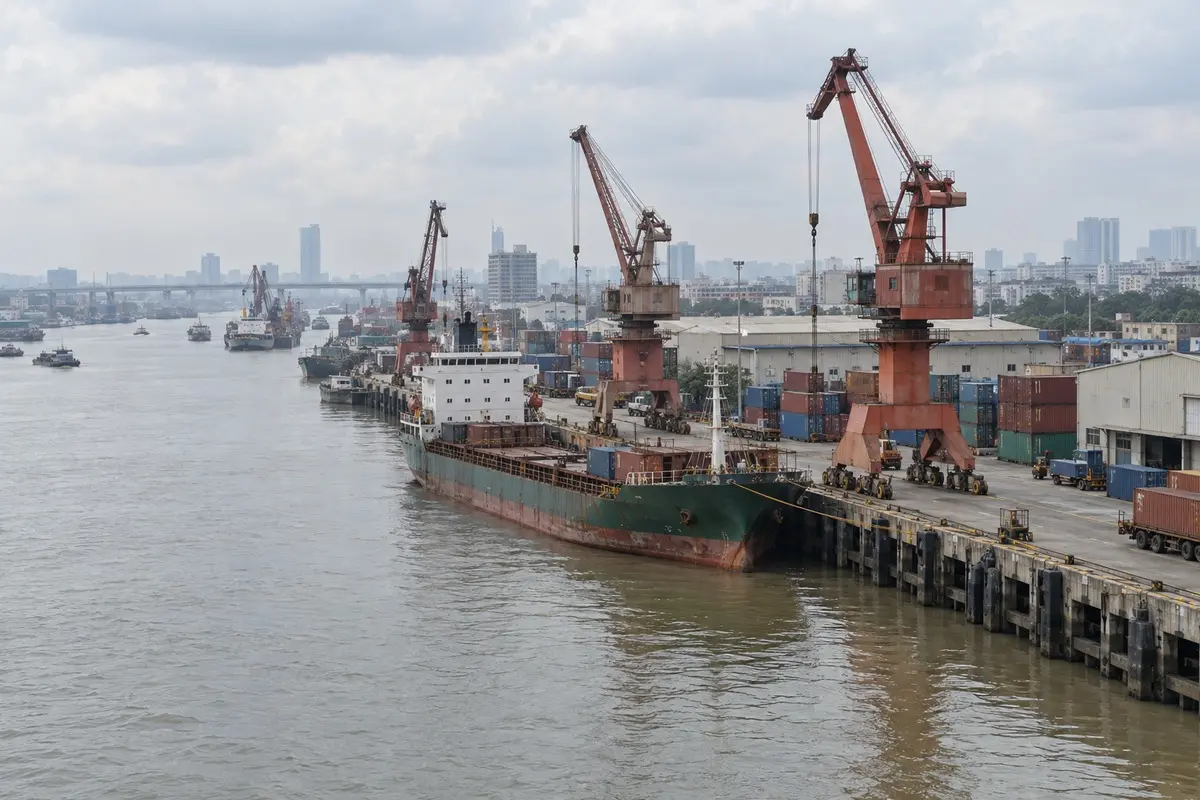
Port of Huangpu
Most goods in world trade travel by ship. UNCTAD estimates that around 80% of the volume of international goods trade moves by sea ("Review of Maritime Transport"). So ports sit at the center of global supply chains. This article lists the main ports in the world in 2026. It uses full-year 2025 data, because 2025 is the latest complete year.
A port is a place where ships load and unload cargo. Some ports mainly handle oil, coal, or grain. This list looks at container ports only. In this article, a main port is a port that moves a very large number of containers each year.
Experts measure container traffic with a unit called TEU. One TEU equals one 20-foot container. A 40-foot container counts as two TEU. The yearly totals include both full and empty boxes (Cohen). People call this yearly total "throughput."
Lloyd's List publishes a ranking of 100 container ports every year. In 2025, these 100 ports handled 792.2 million TEU together. This total was 6.3% higher than in 2024 ("One Hundred Container Ports 2026"). The table below shows the top 20.
| Rank | Port | Country/Region | 2025 Volume (million TEU) |
|---|---|---|---|
| 1 | Shanghai | China | 55.1 |
| 2 | Singapore | Singapore | 44.7 |
| 3 | Ningbo-Zhoushan | China | 43.9 |
| 4 | Shenzhen | China | 35.4 |
| 5 | Qingdao | China | 32.9 |
| 6 | Guangzhou | China | 28.1 |
| 7 | Busan | South Korea | 24.9 |
| 8 | Tianjin | China | 24.0 |
| 9 | Jebel Ali (Dubai) | UAE | 15.6 |
| 10 | Port Klang | Malaysia | 15.1 |
| 11 | Johor | Malaysia | 15.1 |
| 12 | Rotterdam | Netherlands | 14.2 |
| 13 | Antwerp-Bruges | Belgium | 13.6 |
| 14 | Hong Kong | China | 13.0 |
| 15 | Xiamen | China | 12.5 |
| 16 | Tanger Med | Morocco | 11.1 |
| 17 | Laem Chabang | Thailand | 10.5 |
| 18 | Los Angeles | USA | 10.2 |
| 19 | Suzhou | China | 10.2 |
| 20 | Beibu Gulf | China | 10.1 |
The figures come from Lloyd's List, and Visual Capitalist reported the full list (Cohen).
China leads the list by far. Nine ports in mainland China are in the top 20, and Hong Kong is also on the list. Chinese ports handled more than 40% of all the boxes in the full Lloyd's List ranking ("One Hundred Container Ports 2026"). Only four ports in the top 20 are outside Asia and the Middle East. They are Rotterdam, Antwerp-Bruges, Tanger Med, and Los Angeles.
Shanghai and Singapore are both huge, but they work in different ways. Shanghai pulls cargo from a wide area. River boats and trains bring boxes from factory areas along the Yangtze River. Singapore is mainly a transfer stop. Ships drop boxes there, and other ships carry them to new places. Singapore has links to more than 600 ports (Cohen).
Los Angeles is the busiest container port in the U.S., but it ranks only 18th in the world. Shanghai handled more than five times as many TEU. Still, Los Angeles and nearby Long Beach handled about one-third of U.S. sea container trade with other countries in 2025 (Cohen). Our guide to the 10 largest ports in North America covers these U.S. gateways in more detail.
A busy port is not always a fast port. The World Bank's Container Port Performance Index ranks ports by how long ships stay in port ("Container Port Performance Index 2025"). In the 2025 index, Fuzhou ranked first, Dalian ranked second, and Salalah in Oman ranked third ("Chinese Ports Dominate"). None of these three ports appears in the top 20 by volume.
The race for second place is close in 2026. In the first half of 2026, Ningbo-Zhoushan handled about 22.9 million TEU. Singapore handled about 22.7 million TEU in the same period, so Ningbo moved into second place ("China Gains"). Full-year 2026 data is not available yet. So the final 2026 ranking is still unknown.
Many of the main ports in the world are on the Chinese coast. So many China-to-U.S. shipments start at one of these ports. Port size matters, but it is not the only factor. Importers can also compare transit time and the speed of each port before they book. Efan Logistics offers sea freight from China to the USA. The company also has warehouse support in port cities such as Shenzhen and Tianjin.
Tell us your cargo details. We help U.S. importers, Amazon sellers, and e-commerce businesses arrange shipping from Chinese suppliers to U.S. warehouses, stores, or FBA centers.