Oct 10, 2026
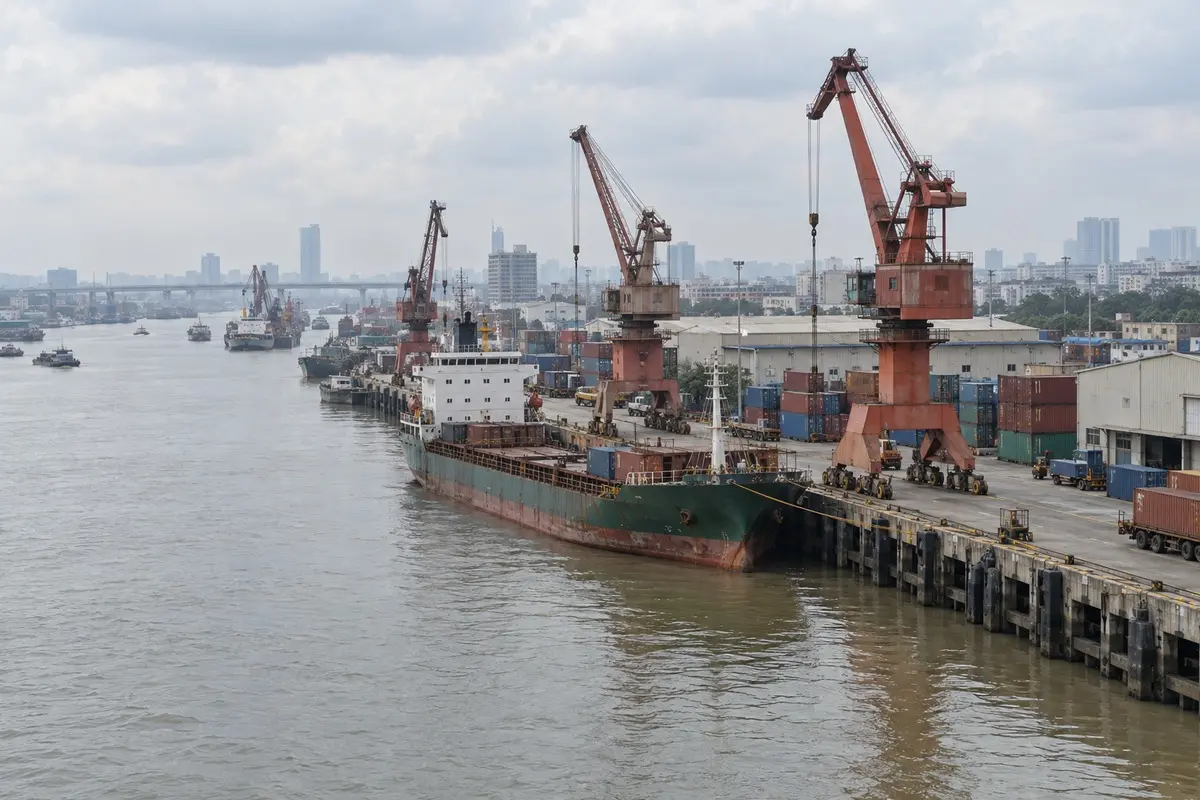
Port of Huangpu
Amazon FBA carton labeling requirements tell sellers how to mark every box they send to an Amazon fulfillment center. Amazon says that boxes without the required FBA box ID label may lead to blocked future shipments ("Shipping Label Requirements"). The same rules apply whether the cartons move by sea freight or by air. This guide explains the key terms, compares the main label types, and lists what export cartons from China need.
An FBA carton label is the FBA box ID label. Sellers print this label from their shipment workflow in Seller Central. The label links one physical box to one inbound shipment. Each box needs its own label, and this includes a box that comes straight from the manufacturer ("Shipping Label Requirements").
The carton label is not a product label. A product label, often called an FNSKU label, goes on each sellable unit inside the box. FNSKU stands for Fulfillment Network Stock Keeping Unit.
Amazon lists these main rules for box labels.
Weight also affects labels. Amazon's standard limit for one box is 50 lb, unless the box holds one oversize item that weighs more. A single item over 50 lb needs a "Team Lift" label on the top and sides of the box. A single item over 100 lb needs a "Mechanical Lift" label in the same places ("Shipping and Routing Requirements").
Sellers often mix up four kinds of labels. The table below shows how they differ.
Label | What it identifies | Where it goes | How many |
|---|---|---|---|
FBA box ID label | One box in an FBA shipment | A flat side of the box | One per box |
Carrier label (small parcel) | The parcel for UPS, FedEx, or another carrier | A flat side of the box, not over the box ID label | One per box |
Pallet label | One pallet in an LTL or FTL shipment | Top center of each pallet side | Four per pallet |
FNSKU label | One sellable unit | The product or its package | One per unit |
A small parcel delivery (SPD) box carries a box ID label and a carrier label. A pallet shipment adds four pallet labels, one on the top center of each side ("Shipping Label Requirements"). The boxes on the pallet still keep their own box ID labels. So sellers who move larger loads by LTL freight need both kinds of labels.
U.S. customs rules also apply to export cartons. U.S. Customs and Border Protection (CBP) says every foreign article must show the English name of its country of origin. The mark must be easy to read. The law gives some exceptions ("Marking of Country of Origin").
The rules also cover containers. Under 19 CFR 134.22, the outer container must show the origin when the article itself is free from marking. A container with the name and address of a U.S. importer, distributor, or other U.S. company also needs an origin mark close to that address. The rule gives "Contents made in France" as an example ("19 CFR § 134.22").
FBA cartons often carry a U.S. warehouse address on their labels. This article does not judge whether the rule covers every FBA carton, so sellers should ask their customs broker. A team that handles customs clearance can also check the marks before the cargo ships.
Many sellers check and fix labels at a consolidation warehouse in China. Efan's China warehouse and consolidation service offers packing, repacking, labeling, and palletizing before the cargo ships to the U.S. Amazon can change its rules at any time, so sellers should check Seller Central before each new shipment.
"19 CFR § 134.22 - General Rules for Marking of Containers or Holders." Legal Information Institute, Cornell Law School, www.law.cornell.edu/cfr/text/19/134.22.
"Marking of Country of Origin on U.S. Imports." U.S. Customs and Border Protection, 22 May 2024, www.cbp.gov/trade/rulings/informed-compliance-publications/marking-country-origin-us-imports.
"Shipping and Routing Requirements." Amazon Seller Central, Amazon.com Services LLC, sellercentral.amazon.com/gp/help/external/G200141510.
"Shipping Label Requirements." Amazon Seller Central, Amazon.com Services LLC, sellercentral.amazon.com/gp/help/external/G200178470.
Tell us your cargo details. We help U.S. importers, Amazon sellers, and e-commerce businesses arrange shipping from Chinese suppliers to U.S. warehouses, stores, or FBA centers.