
Jul 02, 2026
ETA vs. ETD vs. ATD vs. ATA in Shipping: Meaning and Key Differences
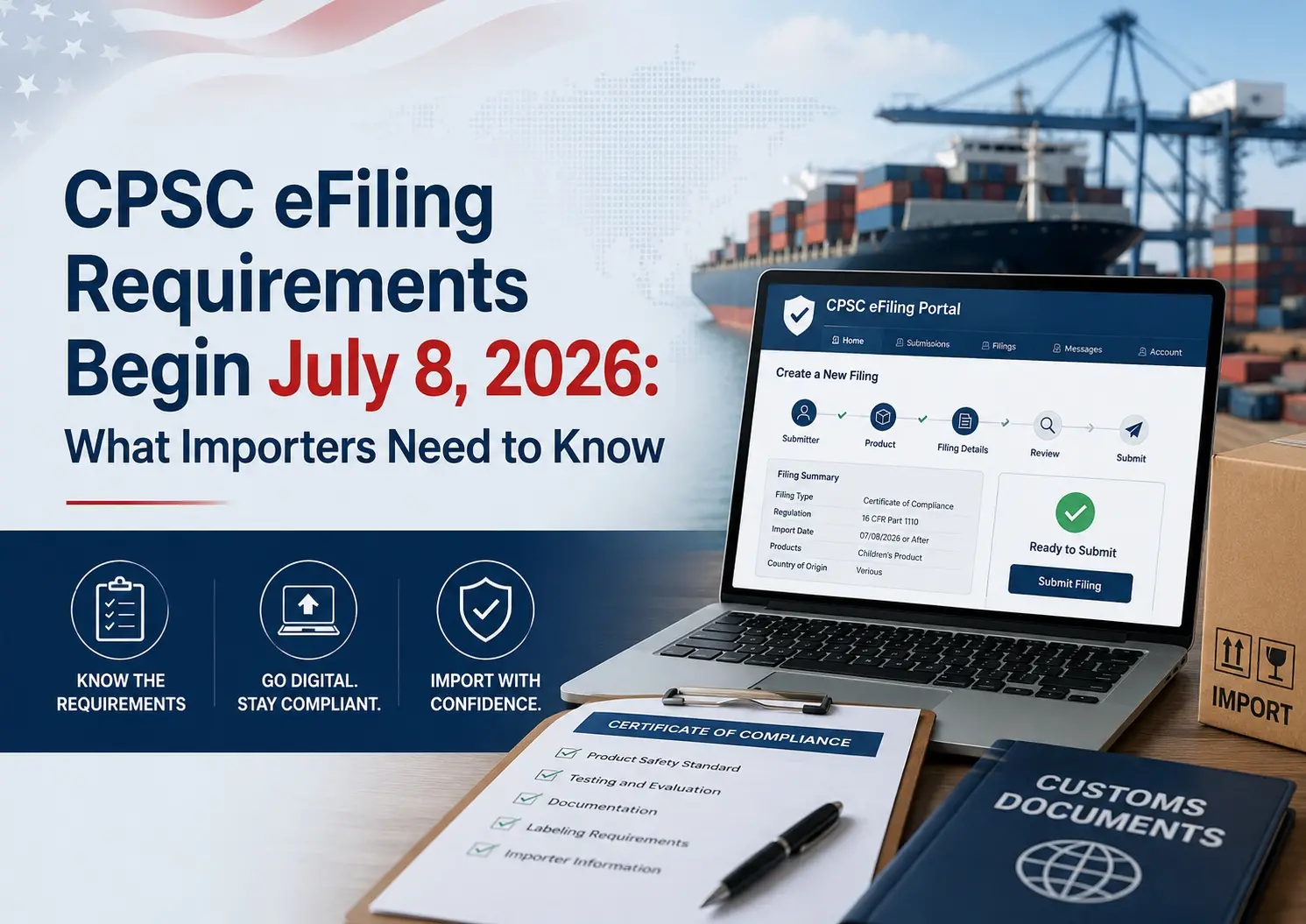
On July 8, 2026, U.S. Customs and Border Protection issued CSMS #69177694 about the Consumer Product Safety Commission’s CPSC PGA Message Set for eFiling. This update matters to importers, customs brokers, and companies shipping consumer products into the United States.
The key point is simple. CPSC eFiling is still moving forward. However, CPSC clarified that it is not asking CBP to reject entries only because CPSC PGA Message Set data is missing. CBP’s CSMS states that CPSC is implementing its PGA Message Set beginning July 8, 2026, but CPSC has chosen not to require ABI software to block filings with missing or incomplete CPSC PGA data for HTS codes marked with “MUST” flags. (GovDelivery)
This does not mean importers can ignore CPSC requirements. It only means the entry system should not automatically stop every shipment because a CPSC message is missing. Importers still need to determine whether their products are subject to CPSC certification and eFiling requirements.
CPSC’s certificate rule updated the requirements for products that are domestically manufactured and imported. For general imported consumer products that are subject to CPSC certification, the effective date is July 8, 2026. For products entered from a Foreign Trade Zone, the effective date is January 8, 2027. (U.S. Consumer Product Safety Commission)
CPSC also states that importers of consumer products subject to CPSC certification must electronically file certificate data as of the relevant effective date. This filing is done through CBP’s Automated Commercial Environment, also known as ACE, using a Partner Government Agency Message Set. (U.S. Consumer Product Safety Commission)
The latest CBP message focuses on how ABI software and entry filing systems should treat CPSC data.
CPSC says software providers are not expected to require filers to provide a CPSC PGA Message Set for every HTS code, even when a CP1 or CP2 flag appears. CPSC also says filers are allowed by CPSC regulation to send no CPSC message even if the HTS code is flagged as CP1 or CP2. However, CPSC encourages advisory messages so filers know that PGA data may be required depending on the HTS code and the product. (GovDelivery)
In practical terms, the CP1 or CP2 flag should be treated as a warning signal. It should not be treated as automatic proof that the shipment must be rejected. The importer and broker still need to review the product, the HTS code, and the CPSC rules that may apply.
This update reduces the risk of system-level filing blocks. However, it does not remove compliance risk.
If a product is regulated by CPSC and requires certification, the importer must still prepare accurate certificate data. CPSC’s implementation guide says certificate data may be submitted through a Full PGA Message Set or through the CPSC Product Registry with a Reference PGA Message Set. (U.S. Consumer Product Safety Commission)
CPSC lists seven main certificate data elements for regulated finished products: product identification, applicable rules or testing exclusions, certifier identification, records contact, manufacture date and place, test date and place, and attestation. (U.S. Consumer Product Safety Commission)
For repeated imports of the same regulated product, the Reference PGA Message Set may be more efficient because the importer can store certificate data in the CPSC Product Registry and transmit a shorter reference at entry. CPSC’s FAQ also states that the Product Registry is not required if the importer only plans to file Full PGA Message Sets. (U.S. Consumer Product Safety Commission)
Yes, if the product requires CPSC certification. CPSC’s FAQ states that there is no Section 321 de minimis exemption for eFiling when the product requires certification. It also says Disclaim PGA Message Sets are not required, although CPSC encourages them because they may help improve risk scoring. (U.S. Consumer Product Safety Commission)
This point is important for e-commerce sellers and importers using small parcel channels. Low value does not automatically mean no CPSC obligation.
Importers should not read CSMS #69177694 as permission to ignore CPSC eFiling. A better reading is this: CBP and ABI software should not automatically reject every CP1 or CP2 flagged entry because of missing CPSC data, but importers remain responsible for determining whether certificate data is required.
Importers should review their HTS codes, product categories, certificate records, and broker filing process. CPSC’s HTS guidance also says its HTS list is not all-inclusive, so importers should not rely only on one list to decide whether a product needs certification.
Before shipping consumer products to the United States, importers should confirm three things:
First, the product’s HTS code is correct. Second, the product’s CPSC certification status is clear. Third, the broker has the data needed to file a Full PGA Message Set, a Reference PGA Message Set, or no CPSC message when the product does not require one.
CBP CSMS #69177694 does not cancel CPSC eFiling. It clarifies how the filing system should handle missing CPSC PGA Message Set data.
For importers, the safest approach is still to prepare early. A shipment may not be automatically rejected by software only because a CPSC message is missing, but missing or inaccurate certificate data can still create compliance questions, exams, holds, or delays. Importers should work with their suppliers, testing partners, and customs brokers before the cargo arrives in the United States.
This article is for general trade compliance information only. Importers should review the official CPSC and CBP guidance and consult qualified compliance professionals when needed.
U.S. Customs and Border Protection. “CSMS #69177694 - Information from the Consumer Product Safety Commission (CPSC) Related to CPSC’s PGA Message Set (eFiling) Beginning July 8, 2026.” Cargo Systems Messaging Service, 8 July 2026. (GovDelivery)
U.S. Consumer Product Safety Commission. “Update: Certificates of Compliance and eFiling.” CPSC.gov. (U.S. Consumer Product Safety Commission)
U.S. Consumer Product Safety Commission. “eFiling Frequently Asked Questions.” CPSC.gov. (U.S. Consumer Product Safety Commission)
U.S. Consumer Product Safety Commission. “CPSC Guidance and HTS List for the Electronic Filing of Certificates of Compliance.” CPSC.gov, Jan. 2026.
Tell us your cargo details. We help U.S. importers, Amazon sellers, and e-commerce businesses arrange shipping from Chinese suppliers to U.S. warehouses, stores, or FBA centers.