Jul 08, 2026
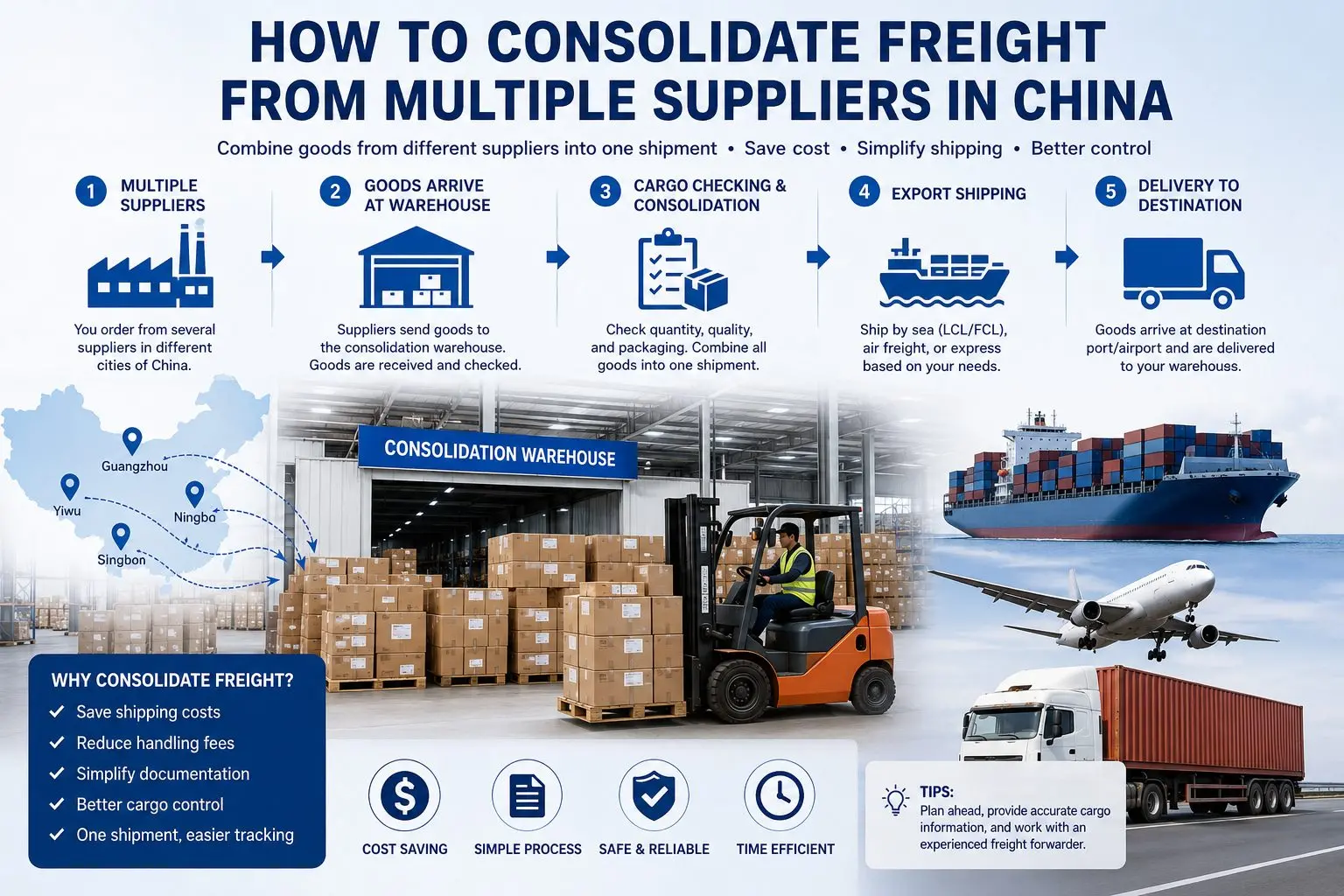
How to Consolidate Freight from Multiple Suppliers in China
Many U.S. importers need a customs bond, but they often do not know which type to choose. This guide compares the customs bond single entry vs continuous options in plain words. It uses official U.S. government sources.
U.S. Customs and Border Protection (CBP) uses bonds to make sure the government gets the money it is owed. CBP's public guide on how it sets bond amounts defines a bond as a contract between the importer and a surety company. The surety company promises to pay if the importer does not pay or does not follow the rules. CBP is the third party that benefits from this contract (U.S. Customs and Border Protection 8).
The bond does not pay your import costs for you. You still owe the duties, taxes, and fees on each entry.
CBP calls this bond a "single transaction bond." It covers one transaction only (U.S. Customs and Border Protection 8). If an entry needs a bond and no continuous bond is on file, CBP requires this type (14).
The amount is usually at least the entered value of the goods plus all duties, taxes, and fees. Restricted goods follow a stricter rule. For those goods, the bond must equal three times their value (U.S. Customs and Border Protection 14).
Here is a simple example. A shipment has an entered value of $20,000 and owes $5,000 in duties, taxes, and fees. The bond would need to be at least $25,000.
A continuous bond covers many transactions over one year. It renews on its own each year, and it stays in effect until someone ends it (U.S. Customs and Border Protection 8).
For importers, the minimum amount is $50,000. CBP also looks at 10% of the duties, taxes, and fees from the past 12 months. It uses the higher number. CBP sets the bond in steps of $10,000 up to $100,000. After that, each step is $100,000 (U.S. Customs and Border Protection 12).
Here is another example. An importer paid $720,000 in duties, taxes, and fees last year. Ten percent of that is $72,000. CBP rounds it up, so the bond would be $80,000.
Feature | Single Entry Bond | Continuous Bond |
|---|---|---|
Coverage | One transaction | Many transactions over one year |
Term | Ends with that transaction | Renews each year |
Usual amount | Entered value plus duties, taxes, and fees | $50,000, or 10% of last year's duties, taxes, and fees if higher |
How often you buy it | Each shipment | Once, then it renews |
Best fit | One-time or rare imports | Regular imports |
A single entry bond often fits a business that imports only once or twice a year. For example, a seller may test a new product with one small LCL shipment. One single entry bond can cover that trial order.
A continuous bond usually fits a business that imports often. One bond covers every entry in the bond year. The importer does not need a new bond for each shipment. Bond prices vary by provider, so this guide does not list them.
Ocean shipments also have bond rules for ISF filing. A single transaction ISF bond must be at least $10,000. A continuous bond for ISF alone must be at least $50,000 (U.S. Customs and Border Protection 25).
President Trump signed Executive Order 14411 on June 3, 2026. The order tells the Department of Homeland Security to raise minimum bond coverage for importers of record within 180 days. It also calls for limits on continuous bonds for foreign importers of record. A foreign importer could use one only if CBP agrees that the money owed is fully protected (United States, Executive Office of the President 35125-26). The final numbers depend on later action by CBP. At the time of writing, this guide does not know the new amounts.
The right bond depends on how often you import. A single entry bond fits rare shipments. A continuous bond fits steady imports. A licensed customs broker can confirm the exact amount for your goods. Efan Logistics also coordinates customs clearance services for China-to-U.S. shipments.
Tell us your cargo details. We help U.S. importers, Amazon sellers, and e-commerce businesses arrange shipping from Chinese suppliers to U.S. warehouses, stores, or FBA centers.